
The Missing Middle: How to Grow Your Mid-Level Donor Revenue
July 21, 2026Eric Etka and How Journey House Recovery Center Stopped "Playing Nonprofit"
July 22, 2026Eric Etka and The Charity Maverick Project

Eric Etka has launched The Charity Maverick Project on behalf on nonprofits EVERYWHERE! Let’s hear what this business expert has to share about the patterns he’s identified and the changes we have to make. Here’s the way Eric sees the state of our sector:
If you are a nonprofit CEO, you probably have a strange relationship with your Form 990.
You sign it, you file it, you hope no one looks too closely, and a small part of you wonders what it is saying about you behind your back.

On paper, your organization might look “fine.”
Programs are running, payroll is met (most months), the audit letter isn’t on fire.
But inside, your calendar feels like triage, your board wants clarity you can’t quite give, and every new year starts to feel like a reset, not a step forward.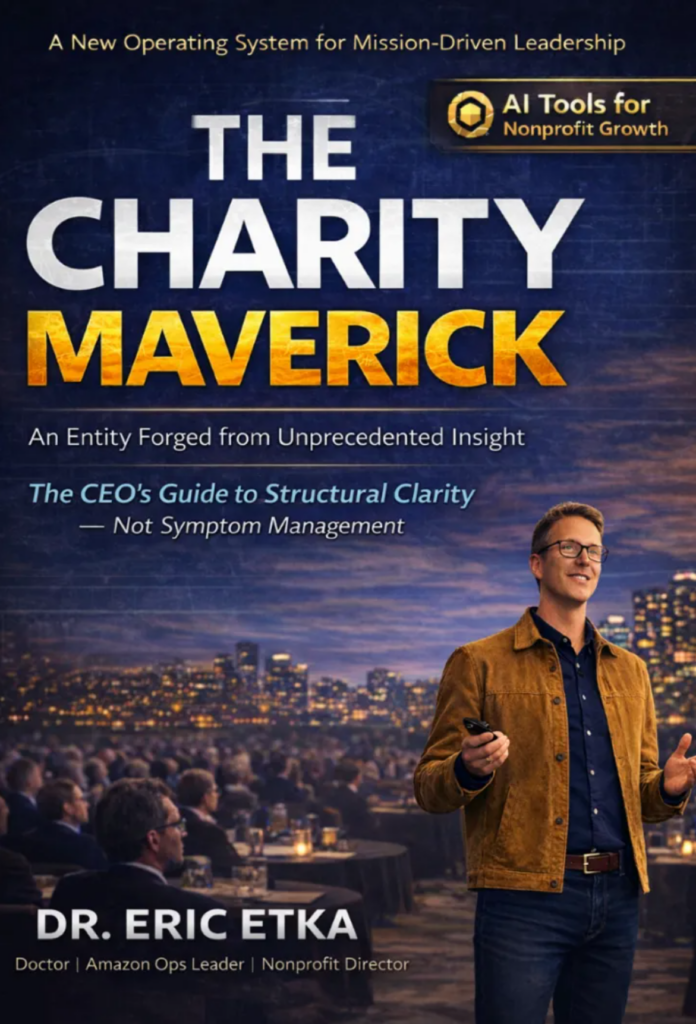
When I started The Charity Maverick Project, I thought this tension was my own story.
Then I sat down with more than 40 nonprofit CEOs and executive directors, from small, scrappy shops to eight‑figure institutions, and heard the same sentence in different words:
“I feel like I must be failing, because this shouldn’t be this hard.”
That line is the real starting point of everything you are about to read.
Eric Etka Uncovers What 40+ struggling (and then successful) CEOs had in common
Those interviews became my real education.
Some of the leaders were still in the struggle; others had somehow “figured it out” and built calmer, more powerful organizations.
Across all of them, three patterns kept surfacing:
- The struggling CEOs blamed themselves.
They interpreted funding volatility, staff burnout, and board drama as personal incompetence. - The breakthrough CEOs talked about structure.
They could point to specific design changes, new revenue mix, different org chart, clearer decision rights, that changed everything. - Almost none of them had been taught to read their Form 990 as a structural document.
They saw it as a tax return, not as a public X‑ray of their design.
The more conversations I had, the clearer it became:
People were carrying structural problems and interpreting them as personal failures.
Once a CEO reclassified the problem, from “I’m the issue” to “the system is wired this way”, their decisions changed.
They got braver with boards, clearer with staff, and more honest with donors.
Those interviews were the genesis of The Charity Maverick, and they are the reason the 990 Tool exists at all.
You are not the problem. The structure is.
Here is the belief system that emerged from those conversations and became the backbone of The Charity Maverick:
- You are not the problem.
- Your staff are not the problem.
- The structure is usually the problem.
- Systems create behavior.
- Money tells the truth.
- Growth amplifies structure.
Most nonprofit CEOs were trained to carry structural issues on their backs and interpret them as private shortcomings.
If revenue is lumpy, you assume it is because you are bad at fundraising.
If staff are exhausted, you assume you are bad at leadership.
If the board is restless, you assume you are bad at strategy.
But when we actually look under the hood, exactly as those “figured it out” CEOs did, we usually find something else:
- Revenue dangerously concentrated in one or two sources.
- Infrastructure starved while programs are overextended.
- Cash razor–thin for the level of risk you are carrying.
Those are not character defects.
They are design patterns.
And the clearest public X‑ray of those patterns is already in your hands: your Form 990.
Your 990 is more than compliance. It is a donor‑facing risk report.
In the Genesis of The Charity Maverick, I describe a pivotal moment: realizing that serious donors were quietly using the 990 as a risk dashboard while most CEOs treated it like a receipt.
To them, the 990 answers questions like:
- How exposed is this organization if a single grant or benefactor disappears?
- Is this team investing in growth or slowly eroding around the edges?
- Do compensation, overhead, and reserves look aligned with the mission and scale?
If you do not know how to read your own 990 the way they do, you are flying structurally blind.
You are doing your best to solve emotional and strategic problems without ever seeing the design that is producing them.
That is why I built the 990 Risk Analyzer and wrote The Charity Maverick ebook.
If you want to see this in your own numbers as you read the ebook, you can get the Maverick 990 Snapshot at [link].
990 Financial Truth Diagnostic: what it actually does
The 990 Financial Truth Diagnostic: grew directly out of those 40+ interviews and dozens of 990 reviews.
It is a donor‑style risk diagnostic for your organization, but written in CEO language.
When we run your 990 through the Tool, we look for patterns like:
- Revenue concentration risk
How much of your funding depends on a single grant, gala, or relationship. - Liquidity knife‑edge
Whether your cash position gives you room to maneuver or keeps you in permanent survival mode. - Starving the revenue engine
Whether you are under‑investing in development, systems, and leadership, the very functions that generate future stability.
Then we translate those patterns into a structural archetype:
- Survival‑mode charity.
- Growth‑primed organization.
- Major‑gift‑ready institution.
You receive a concise written brief that explains:
- What your 990 is signaling to sophisticated donors.
- The 2–3 structural shifts most likely to change that signal.
- How those shifts connect directly to the stress you have been carrying.

For many CEOs, it is the first time anyone has shown them their own organization the way an investor would, and the first time their private overwhelm makes structural sense.
The Charity Maverick: the playbook behind the tool
The ebook The Charity Maverick: Taking the Cause to Zero is the narrative spine behind the diagnostic.
It tells the story of how those interview patterns, 990 reviews, and my own journey through healthcare, Amazon operations, and nonprofit leadership turned into a new way of thinking about charities.
Inside, you will find:
- Why growth amplifies your existing structure, for good or harm.
- How “money tells the truth” about what your organization is actually built to do.
- The progression from Charity Leader (holding everything together) to Charity Maverick (re‑wiring structure) to Impact Maverick (designing obsolescence to the problem itself).
When you read it with your 990 brief in hand, you can locate yourself in the same journey those 40+ CEOs described.
You are no longer staring at isolated numbers; you are seeing a plotline, and you have language to invite your board and team into that plotline with you.
A brief word about shame (and why this matters now)
If you have been carrying around a quiet story that says, “If I were a better leader, we would not be in this position,” I want to say what my research made inescapable:
The best leaders I interviewed felt that way at some point.
What changed their trajectory was not a miracle grant or a heroic workweek, it was seeing the structure clearly enough to redesign it.
The single most powerful sentence that emerged from this whole project was:
People are often carrying structural problems and interpreting them as personal failures.
Once a CEO understands that difference, everything changes.
They stop hiding.
They start inviting.
They begin to lead the redesign their organization has needed for years.
Two practical next steps
If any part of this has felt uncomfortably accurate, here are two steps that came directly out of the journeys of those “figured it out” CEOs.
- Get the 990 Financial Truth Diagnostic for your Organization
- We will run your most recent 990 through the 990 Risk Analyzer.
- You will receive a short, plain‑English brief that explains what your numbers are signaling about donor risk and structural health.
- No public shaming, no jargon, just the kind of clarity an investor or major‑gift donor would want you to have.
- Buy The Charity Maverick ebook with your 990 Tool report in hand
- Use it to reframe your leadership story from “I’m failing” to “this structure was never designed for the outcomes we now want.”
- Share key pages with your board or leadership team to start a different conversation, one grounded in structure, not blame.
You cannot control every grant cycle, every donor decision, or every staff transition.
But you can control how clearly you see the system you are leading.
Once you can read your 990 like an investor, you are no longer guessing.
You are stepping into the same structural clarity that helped dozens of other CEOs move from quiet frustration to designed impact.
About Eric Etka:

Dr. Eric Etka, DC, BDC brings a unique blend of professional expertise and personal experience to his role as Director of Strategy and Development for Journey House Foundation and Journey House Recovery Center. For 20 years, Eric served as a Doctor of Chiropractic, building a successful practice rooted in patient care and community impact. In 2017, he joined Amazon, where he spent eight years leading large-scale operations, managing teams of over 400 people, and driving improvements in safety, efficiency, and leadership development.
Eric has also worked in healthcare operations and technology, designing systems that improved provider scheduling, credentialing, and patient access to care. His work increased completed visits by 150% and reduced no-shows significantly, showcasing his ability to combine strategy with real-world results. Most importantly, Eric has been sober for 14 years. He understands firsthand the courage, perseverance, and daily commitment it takes to get sober and stay sober. This lived experience fuels his passion for helping others on their recovery journey. At Journey House Foundation, Eric is dedicated to strengthening programs, expanding opportunities, and ensuring that individuals and families in recovery have the support they need to thrive.
Eric Etka
[email protected]
804-929-4064
Eric Etka and The Charity Maverick Project was first posted at Inside Charity.
For more articles like Eric Etka and The Charity Maverick Project VISIT HERE

2 Comments
God bless you richly
Am kabuubi Remegius from masaka Uganda East Africa and God put a burden on my heart to help the poor children in my area to have education and even helping the community with safe and clean water but I don’t have job and money source just struggling with life and l kindly ask you to stand with me in this cause so that I fulfill my dream of helping the needy
Please connect me to more people and organizations to stand with me in forming a foundation which will save and change people’s lives and dreams into reality
At least $100000 so that they get education and fit in the Era of elites and develop the whole world
Thanks
Kabuubi Remegius
Masaka Uganda East Africa
+256703924321
Whatsapp
[email protected]
Eric’s innovative approach with the Charity Maverick Project reminds me of my time launching a grassroots initiative. It’s all about harnessing community strengths! I’d love to learn more about how Ivo Valemont fits into this vision.