
[PODCAST] Merging Without Losing the Mission
November 20, 2026Louis Fawcett Says, “When it comes to charitable organizations EVERYTHING COSTS MONEY!”
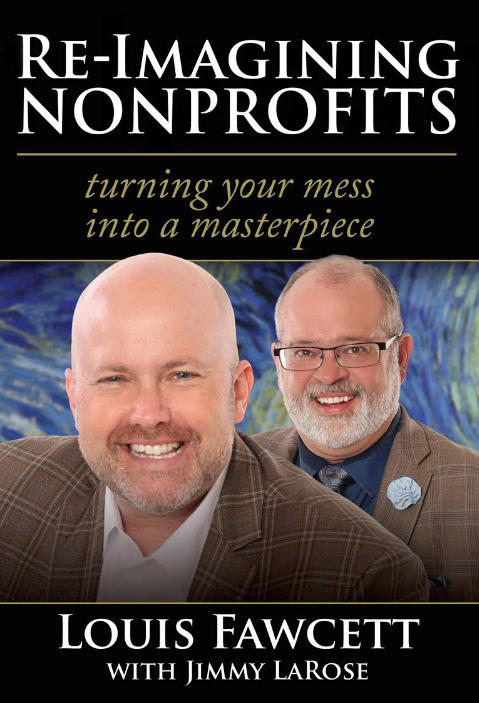
Louis Fawcett Says, “When it comes to charitable organizations EVERYTHING COSTS MONEY!” is excerpted from his nationally acclaimed book RE-IMAGINING NONPROFITS. Here’s what Fawcett has to say about the role money plays in saving and transforming lives.
You know the story well. Thirty-five hundred years ago in Egypt, Pharaoh was conducting a large-scale campaign to build his kingdom. He constructed pyramids, store houses, and other structures to bring attention to himself. To make his dreams possible, Pharaoh enslaved the Israelites. He used them as a free labor source to make his bricks, build his buildings, and work in his fields. The harder the Israelites worked, the worse their lives became. Pharaoh demanded more and more and refused to negotiate or provide incentives for their hard work.
When the Israelites complained, Pharaoh made their work more difficult. He demanded more productivity. The Israelites asked for change, but Pharaoh had a hard heart. He attacked those who opposed him. Pharaoh took his kingdom and power for granted. He thought the Israelites would never leave. He listened to his inner circle rather than the cries of the masses.
Finally, Moses, Aaron, and Myriam lead their people out of servitude. They spoke against Pharaoh. They challenged his authority. They organized themselves, devised a plan, and left Egypt. The seas parted, the Egyptian army was defeated, and the Israelites eventually found their way to the Promised Land.
For decades, nonprofit professionals have labored to change and save lives. But the harder we work, the worse things become. We follow the ways of the past because we are told that success is just around the corner if we just do it the “right way.” We sit at our desks filling out reports only to realize the reports matter to no one. We dutifully attend meetings and wonder why we are having the same conversations we have had for years again and again. We fill out grant applications hoping for the pot of gold at the end of the rainbow, only to see grants awarded to those with insider information and relationships. We continue to hope for board members who will make our organizations better, only to encounter disinterested volunteers who understand little or nothing about the work we do.

We pound out newsletters, email blasts, and social media campaigns only to see a few hundred dollars raised. We exhaust ourselves planning and implementing events only to realize people attend just to drink and eat for free. We watch in dismay as the silent auction sheets remain empty. We sit in worthless strategic planning sessions led by consultants who promise prosperity but only deliver notebooks that sit on shelves gathering dust.
Budgets are cut. Reporting requirements increase. We tell ourselves that if only we work harder, things will get better. Then we realize our children have grown up and our marriages are in shambles because we worked sixty to seventy hours a week in the name of “helping others.” Just one more webinar. Just one more conference. Just one more meeting. Just one more gala. Just one more email.
Louis Fawcett Says, “When it comes to charitable organizations EVERYTHING COSTS MONEY!”
 When will things change? When will deliverance come? Is there any hope? Where do we go now?
The Nonprofit Exodus
The time has come to leave nonprofit Egypt; leave behind the slavish devotion to ways of the past. We can forget about our servitude to strategic planning, feasibility studies, grant writing seminars, conference breakout sessions, hundreds of emails, and ethical standards that aren’t ethical or standard.
No more board development retreats. No more newsletters or email campaigns. No more silent auctions. Death to meetings. Death to sixty-hour work weeks. Death to the same tired advice that never works. The time has come to lay down all the antiquated tools of the past and make the journey to the Promised Land. So, where do we go now?
Being Determined to Change
Here’s the good news: it won’t take forty years to get to the Promised Land. You are closer than you think. You will need to decide that the pain of change is less than the pain of the status quo. You will need to commit change management that causes some people to be upset and leave the staff or the board. You will need to stay on message and stay the course. But this is how you get on the road to the Promised Land. This is how your mess turns into a masterpiece.
Here are some of the keys to success:
- Strong CEOs who operate their organizations like corporations rather than hobbies with shoestring budgets
- Pay scales that honor your hard work and experience with good salaries, benefits, and performance-based bonuses
- Small, expert boards who don’t presume to do anything, other than provide advice and accountability
- Resources that offer real solutions for real problems
- A focus on nonprofit leadership rather than cultural issues better addressed by other organizations
- Colleagues on the journey who are authentic, supportive, joyful, and collaborative
- Credentialing that is achievable and affordable
- Mentors who have been in the trenches and honor you for your service
- Funding from donors (your customers) who are excited to be part of your work because you are helping them achieve their goals
- The freedom to explore enterprise models that take calculated risks to foster long-term growth
- Shorter work weeks and more peace in your personal lives
- Heroic missions of scale that seek to eradicate problems so completely that money chases after them
The road to the Promised Land is not without risk and hardship. There will be challenges and obstacles. The Promised Land will not be everything you want it to be. But it will be a hundred times better than being in nonprofit Egypt.
Appreciate Your Donors
If you truly wish to help the marginalized, the hopeless, the homeless, the victims of racism, the hungry, the addicted, and the abused, you will need to develop a love and appreciation for your donors. If you take time to get to know them rather than rushing to ask for the gift, you will find them to be regular people. Donors have hopes, dreams, fears, and worries just like everyone else. They are people who have money and desire to freely share it with others.
Think Positively, Every Day
Successful fundraising is built on waking up every day thinking positively about your work and the donors you serve. Considering the needs and wants of your donors is the key to raising the most amount of money in the shortest period of time. This approach changes and saves lives.
I’m a person of faith. I understand that there’s a spiritual currency, and that spiritual currency is love, grace, mercy, compassion, and understanding. But we’ve been put in this world. And as long as we’re in this world and as long as it’s up to us, then the currency we’ve been given to achieve impact is money.
What would it look like if you had twelve months of operating expenses in the bank for your nonprofit? What would it look like if you had an endowment that was spinning off two hundred thousand dollars a year for your nonprofit? What would it look like if you had money in the bank so you could take some risks to achieve greater impact?
We’ve been told for far too long that it’s different in the nonprofit sector—that nonprofit financial management is not like a for-profit business. The truth is exactly the opposite: it is no different in the nonprofit world. The common sense, free-market principles that work every day in successful corporations also work for nonprofits.
Investments, Not Donations
Please stop thinking that if you call somebody for twenty-five dollars, you’re going to achieve significant impact. Please stop the bad math of thinking that if a thousand people give $1,000, you’ll have $1 million. This is not the way it works. Gifts of $10,000+ drive organizations to success. These major gifts are investments in change, not donations.
A donation is $1 to a guy on the corner. A donation is $10 to the American Red Cross. A donation is $25 to the homeless shelter. A donation is $50 to your church. A donation is $100 to your kid’s school.
Do you really think these donations are achieving significant impact? It is true that for large organizations with hundreds of staff members, small donations can make a difference. But the reality is most nonprofits have just a handful of staff members—in many cases one staff member—in charge of processing gifts. This means you cannot achieve significant impact through small donations. You must have large investments in your organization’s mission to make an impact.
Focus on the Money
If you are a nonprofit executive wondering how you are going to turn things around, here is the answer—focus on the money. Where do we go now? To the money!
If you are going to serve your communities by growing your impact, you must diversify your revenue streams and show individual donors the value of giving impactful gifts to your organization. Growing your top one hundred donors is the fastest way to achieve new fundraising records with the least amount of staff stress and effort.
Here is the bottom line: Are you ready to commit to a new process to grow your impact and revenue? If so, RE-IMAGINING PHILANTHROPY offers the detailed solutions you need to turn your nonprofit mess into a masterpiece.
ABOUT LOUIS FAWCETT:
 Louis Fawcett, known around the world as CHARITY’S MASTERMIND, has spent the last quarter century growing nonprofits, ministries, and churches across the U.S. and around the world. His personal mission to change and saves lives has driven him to confront the establishment, defy convention and expose the broken systems that wreak havoc on 501(c)(3) corporations. Louis’ critical insights into nonprofit management are changing the way organizations do business.
His long and storied career serving hundreds of impact agencies has turned him into a capacity-building expert and organizational development virtuoso. His thought-provoking “the emperor has no clothes” approach to training leaders has inspired C-Suite Executive, Board Members and Volunteers to transform the groups they serve. He is a gifted truth-teller whose charisma and humor inspire standing-ovations each time he shares his message of clarity and hope.
Louis serves as President of the National Association of Nonprofit Organizations and Executives (NANOE), is a National Development Institute (NDI) faculty member and Senior Counselor with Major Gifts Ramp-Up. He holds a BA from Randolph-Macon, MA from Wake Forest, and MDiv from Lutheran Theological Southern Seminary. Louis wakes up every day focused on serving his heroes – the frontline workers who give their lives to charity.
Louis Fawcett Says, “When it comes to charitable organizations EVERYTHING COSTS MONEY!” was first posted at INSIDE CHARITY
For more articles like Louis Fawcett Says, “When it comes to charitable organizations EVERYTHING COSTS MONEY!” VISIT HERE
