

Kevin Vincent and Tony Farinella's Vision for The Vocation Depot
December 12, 2023Creating Your Own Website? 5 Reasons You Shouldn’t
December 15, 2023The Nonprofit Reformation…a Leader Has Emerged

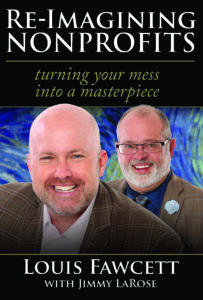 Louis Fawcett’s RE-IMAGINING NONPROFITS…Turning Your Mess Into a Masterpiece is taking our industry by storm. Louis is leading a Nonprofit Reformation to change the way charities do business.
Clemson University’s Dr. Kathleen Robinson has declared, “Louis Fawcett’s RE-IMAGINING NONPROFITS has captured the hearts and minds of the charitable sector. He’s lit the fire we so desperately need.”
National Development Institute’s Jimmy LaRose says, “Louis takes an ’emperor has no clothes’ approach to the piety and crazymaking rampant throughout our sector. RE-IMAGINING NONPROFITS is a page-turner that will have you saying to yourself, ‘YES’, ‘THANK YOU’, ‘FINALLY’, ‘OF COURSE’, ‘WHY NOT?'”
Fawcett is the President of National Association of Nonprofit Organizations and Executives (NANOE).
Here’s a first look at what’s sure to be a bestseller:
Jimmy LaRose: I wrote the industry bestseller, RE-IMAGINING PHILANTHROPY to challenge donors to give differently, to give them a new set of expectations when they share a financial gift. But Louis Fawcett said, “That’s not enough! Jimmy! You go ahead and work with the donors, I’ll work to change nonprofits so donors will more gladly invest!” And out of that effort came Louis’ new book, RE-IMAGINING NONPROFITS.
Louis, It’s always good to be with you. We’ve been here a thousand times. I can’t wait to hear what’s new. Go ahead Pal!
VISIT HERE TO PURCHASE YOUR COPY OF RE-IMAGINING NONPROFITS…TURNING YOUR MESS INTO A MASTERPIECE
Louis Fawcett: Jimmy, thanks so much. You’re exactly right. You wrote REIMAGINING PHILANTHROPY to donors and. What we continue to confront in the nonprofit sector is brokenness within nonprofits, brokenness with the way the staff is structured, brokenness with boards, brokenness with the way donors want to be involved with nonprofits, the entire way the nonprofit sector has been set up and has been handed to us is broken, and it needs to be fixed. That is the passion and motivation behind REIMAGINING NONPROFITS. What I do in the beginning of the book is lay out the brokenness. I describe how bad things are. It’s a look in the mirror. And then in the next ten chapters, I lay out solutions that can be implemented by any nonprofit of any size, anywhere in the country.
Jimmy LaRose: Louis, how do nonprofits TURN THEIR MESS INTO A MASTERPIECE?
Louis Fawcett: Why don’t we review the TABLE OF CONTENTS? Here we go:
RE-IMAGINING NONPROFITS…TURNING YOUR MESS INTO A MASTERPIECE
Chapter 1 – The Mess We’ve Inherited
• Truth Never Fears a Challenge
• More Than Thirty Million People Already Mad at Me
Chapter 2 – The Mess: Why Your Nonprofit is Broken
• Nonprofits Are About Changed and Saved Lives
• Nonprofits Are No Different from Corporations or Families
• Why Does Our Culture Value Lattes over Orphans?
Chapter 3 – Nonprofit Piety and Scams
• The Nonprofit Sector Is Broken
• Nonprofits Bottom Feed on Talent
• Nonprofit Workers Are Expected to Be Poor
• Tesla versus Ford
• The Scam of Donor Advised Funds
Chapter 4 – Nonprofits are Businesses, Not Hobbies
• Gifts to Charities Are Investments, Not Donations
• The ROI of Nonprofits Is Impact
• If You Can’t Run a Business, You Can’t Run a Nonprofit
Chapter 5 – Founder’s Syndrome
• The Story of Mr. Love Thyself
• Founders Can’t Let Go
• Combating Founder’s Syndrome
Chapter 6 – Where Do We Go Now? To the Money!
• The Nonprofit Exodus
• Being Determined to Change
• Appreciate Your Donors
• Think Positively, Every Day
• Investments, Not Donations
• Focus on the Money
Chapter 7 – Solution #1: Treat Your Donors as Your Customers
• Create an Excellent Experience for Your Donors
• Why Philanthropists Give
• Love Your Donors
• Don’t Project Your Feelings
• Nonprofit Product, Marketing, and Sales
• Philanthropists Give to Masterpieces, Not Messes
• Get Rid of Your Desk and Pick Up the Phone!
• Acquire Customers and Upsell Them
• Treat Your Donors as Valued Investors
• Use the Magic Questions
Chapter 8 – Solution #2: Know Your Numbers
• Understand Your Revenue and Expenses in Detail
• Know the Cost of Your Impact, Per Person
• Comprehending Your Numbers Leads to More Revenue
Chapter 9 – Solution #3: The Strong CEO
• Servant Leaders
• Setting Goals to Grow Revenue and Impact
• The Board Hires and Fires the CEO
• The Board Supports the CEO’s Vision
• The Board Evaluates the CEO’s Performance
Chapter 10 – Solution #4: Proper Staff Compensation
• Nonprofits Bottom Feed on Talent
• Nonprofits Can, Without Apology, Pay for Talent
• Nonprofits Should Offer Four Weeks of Vacation
• Nonprofits Can Offer Bonuses for Performance
• Keep Your Employees Happy with Money
• Starbucks Joan versus Nonprofit Suzy
Chapter 11 – Solution #5: Getting Boards Out of the Way
• The Better Board Member Myth
• Stop Relying on Your Boards
• The Consultant on the Jamaican Beach
• Consider a Smaller Board
• The Board Only Offers Advice and Accountability
• Cultivate Your Board Members as Customers
• Consensus Is the Enemy of Progress
• Make Your Board Meetings Fun!
Chapter 12 – Solution #6: Eliminate Piety
• Piety Is a Form of Control
• Piety Is About Feelings; Results Are About Facts
• Don’t Be Afraid to Make a Few People Mad
Chapter 13 – Solution #7: Monetize Every Hour
• The Secret to Success
• Don’t Be a People Pleaser
• Proactively Plan Your Day
• Calculate How Much You Need to Raise Every Hour
• Eliminate Office Time
• Stop Checking Email
• Celebrate Major Gifts!
• Stop Attending Staff Meetings
• Know Your Numbers
Chapter 14 – Solution #8: The Event Live Tally
• Brash Like Ric Flair
• Red Pill or Blue Pill?
• Determine Event Details
• Recruit Table Hosts
• Outline the Run of Show
• Commitment Cards and Live Tally
• Another Excuse to Be Face to Face with Major Donors
Chapter 15 – Solution #9: Your Mission Has a Price Tag
• Three Car Buying Stories
• Serve Your Donors and They Will See the Value
• There is No Overhead
• Don’t Apologize for Including Everything in the Price
Chapter 16 – Solution #10: Face to Face
• Laziness Has Never Saved a Life
• There Is No Substitute for Face-to-Face Asking
• Set the Appointment
• Prepare a Written Proposal
• Listen Genuinely
• Review Case for Support
• Ask Permission to Ask
• Review the Gift Range Chart
• Ask for the Gift
• No Excuses
• Negotiate the Terms
• Determine Clear Next Steps
• Follow Up Relentlessly
• Genuine Thanks and One More Thing
Chapter 17 – Your Masterpiece: Changed and Saved Lives
• Falling Asleep at the Wheel
• We Are Created with a Purpose
• Climb without Ropes
• Seize Your Nonprofit’s Future
• NANOE’s Research on Growing Nonprofits
• Major Gifts Ramp-Up
• Time to Get to Work!
Afterword: The NANOE Reformation
Jimmy LaRose: Louis, why don’t share some of the big ideas readers will discover when they jump into RE-IMAGINING NONPROFITS:
Donors Are Your Customers
If you look at the best corporations in the world, they provide an experience for their customer, and they devote millions and millions of dollars on retaining existing customers and upselling them. And if we can learn to create an experience for our donors and understand that donors will invest more when we invest more in them, then our time priorities begin to shift. Instead of spending 95 to 99% of our time on program service delivery, what if we spent at least half of our time on the needs of our customers, i.e. our donors? So I describe methods for doing that.
Know Your Numbers
Um, then we have to know our numbers. Jimmy, you would be astonished. I talked to nonprofit leaders every day and I’ll say, well, what was your revenue last year? And they don’t know. I’ll say, well, how many, how many people did you help last year? Well, I’m not sure I’ll have to look that up. A corporate executive is expected to know her numbers backward and forward. And so too should a nonprofit executive and staff member know our numbers. Because if we don’t know our numbers, we can’t grow them. Then we need the strong CEO. We’ve talked a lot about that. That’s really important. We need proper staff compensation. Just mention that a few minutes earlier.
Get Your Board Out of The Way
Boards don’t need to be micromanaging the day to day operations of the organizations. Boards need to be there for advice and accountability. We need to eliminate piety. We’ve got to stop thinking about the nonprofit sector as somehow different than another business. It occupies a different tax status.
VISIT HERE TO PURCHASE YOUR COPY OF RE-IMAGINING NONPROFITS…TURNING YOUR MESS INTO A MASTERPIECE
Run Your Charity Like a Business
Your nonprofit has to be run like a business, not a hobby. It’s not about how we feel, it’s about how the numbers are generated. In order to generate those numbers, we have to monetize every hour. We don’t have time to waste on the same old staff meetings, the same old events, the same old tired board meetings. How many nonprofits, Jimmy, uh, the CEO comes out of a board meeting and has got 4 or 5 things to do, and by the time she gets those 4 or 5 things done to report back to the board has to start preparing for the next board meeting. Um, how many nonprofits are spending two hours, three hours a week on staff meetings instead of being out doing their job and focusing on their donors?
Monetize Every Hour
Jimmy LaRose: Louis, let me put you on the spot. We do this from a chair in front of large audiences. What you just talked about was monetizing every hour. Are you able to get your phone? Let’s say it’s a $3 million organization. Do you mind going through that exercise really quick?
Louis Fawcett: Sure, if you have a 3 million, $3 million organization, you’ve got 48 weeks to raise $3 million, which means I want you to have four weeks off. You should have time with your family. You should have time to have fun. Within those 48 weeks, you got 40 hours. It’s not healthy to work 50, 60, 70 hours a week. We should have a normal 40 hour workweek. So if you’re going to raise $3 million over 48 weeks at 40 hours a week, it means that you need to raise $1,562.50 every hour. So if we’re doing anything that’s not worth at least $1,562, Jimmy, then we shouldn’t be doing it.
Quit Doing Fundraising Events
Louis Fawcett: So then we go into events. Events are the bane of most nonprofits existences, right. Because our staff spends hours and hours and hours planning and pulling off these events, and then they’re exhausted and burned out, and then we’re not monetizing them. I mean, how many events have we heard of where we’re only generating 28,000, 45,000, and yet we’re spending hundreds of staff hours. So we have a solution in the book where you have A12 hour event every year, that’s a dinner and a few speakers talking about how lives have been changed and saved by the organization. And then we make an ask and we do a live tally. Jimmy, we’ve done hundreds of these events, and we always raise at least 3 or $400,000, sometimes over $1 million in one evening. The staff is not burned out. The donors are happy that we’ve respected their time with two hours on a Thursday night and people leave feeling great about what they’ve done to help their community.
Show Donors The Price Tag
Then we’ve got to, without apology, put a price tag on our mission. Instead of saying, well, just give what’s on your heart or just give what makes sense to you. By the way, we would never do that with any other product or service in our world, right? The car dealer never says to you, oh, you want to drive off the lot in this Hyundai? We’ll just give what’s on your heart. No, there’s a price tag. If you want a product or a service, you have to assess the value of that product or service. And it’s no different in the nonprofit sector. And so we have to start asking people for concrete amounts. Uh, Jimmy, if you’d like to help 300 kids in our after school program, we thought you’d like to consider an investment of $25,000 that would enable us to serve those 300 kids for six months of this year. See, that puts a price tag for you as the donor. Now you’ve got a place to start. You may decide to give more. You may decide to give less. But now you know what the impact cost. And we’ve got to do that without apology. And that number has to include everything. Not just would it cost for the books or the pencils or the curriculum, but everything that it costs to run the organization has to be included in your mission’s price tag.
Meet With Donors Face-To-Face
And finally, Jimmy, we’ve got to spend time with people one on one. And I know it’s a lot of work, and it’s a lot of work to call people to schedule meetings, to reschedule meetings. But we find over and over again, Jimmy, that when we sit down with our donors, when we sit down with our board members, when we sit down with our staff members, when we sit down with our volunteers one on one and have a conversation about getting to know each other and then transition that conversation to, I’d like to run some ideas by you. I’d like to get your advice on what we’re facing with this nonprofit. We find over and over again. Those conversation conversations lead significantly to growing revenue and growing impact. Contrast that to the CEO, who wants to go into a staff meeting or a board meeting or an event and cast this wonderful vision and expect everyone to get behind it, it just doesn’t work that way. We have to start one-on-one.
RE-IMAGINING NONPROFITS…Turning Your Mess Into a Masterpiece, authored by Louis Fawcett, was published by National Association of Nonprofit Organizations & Executives (NANOE)
RE-IMAGINING NONPROFITS…Turning Your Mess Into a Masterpiece was first posted at Inside Charity
For more articles like RE-IMAGINING NONPROFITS…Turning Your Mess Into a Masterpiece VISIT HERE
 ABOUT THE AUTHOR:
When asked what motivates him, Louis Fawcett says, “I wake up every day trying to figure out how to change and save more lives. That is my agenda. In this world, the only way to maximize impact to change and save lives for generations is with money. The more money we raise, the more children and families we can help. Email and social media don’t count; the way to raise millions of dollars is to pick up the phone, meaningfully engage a donor and meet them where they are – spiritually, mentally and geographically.”
Louis is President of National Association of Nonprofits & Executives (NANOE)

3 Comments
I’m considering buying the book and sending it anonymously to send to a founder that needs to open his eyes and realize he’s got founders syndrome; however, I’m concerned about the chapter advising CEOs to get their board out of their way. In this case, the Board only exists to meet IRS requirements. They don’t do anything now but should be! If your advice is that the board has no business with day to day operations, and the Executive Director is KING, that’s not the message to send. Can you tell me more about this chapter?
Dear Anonymous,
Thank you for serving in our sector. You’re our hero. Please email [email protected] with your question. In the meantime, here’s what Louis & NANOE believe about great boards. (Excerpted from Jimmy LaRose’s RE-IMAGINING PHILANTHROPY [this book is actually written to board members!])
By the way, I FIGURED THIS MESS OUT. Let me tell you about GREAT BOARDSMANSHIP.
Here’s what it’s not:
-Boardsmanship is not Governance
-Boardsmanship is not Visioning
-Boardsmanship is not Policy-Making
-Boardsmanship is not Volunteerism
Boardsmanship is not Governance. Don’t kid yourselves. UNPAID
BOARD MEMBERS DON’T GOVERN. Actual governance occurs when
a person (with a full-time salary) supported by various paid staff (the
formation of a government) is empowered to perform the daily tasks of
decision-making and oversight. Strong CEOs GOVERN!
Boardsmanship is not Visioning. VISION is the way MISSION is
achieved and is never the responsibility of the board because the board
isn’t being paid to accomplish it. STRONG CEOs ARE TRUSTED TO
CREATE VISION. (I agree that board members hold their compensated
leader accountable to achieve MISSION.) Here’s what you do. Hire a
strong CEO who has a history of designing VISION that accomplishes
MISSION in ways you never dreamed possible. Believe me, strong CEOs
are already doing it their way even if they feel the need to label their
activities as “BOARD VISION.”
Boardsmanship is not Policy-Making. Hire a CEO whose depth
of experience and formal education has already equipped them as a
management expert. The right CEO has been properly trained to oversee
the creation of policies that work. Board Members never write policy
anyway. Someone else does the heavy-lifting and they rubber stamp it.
Boardsmanship is not Volunteerism. Eliminate the special events
committee. Eliminate the fundraising committee. Eliminate the public
relations committee. Eliminate the strategic planning committee. (Here’s
a good rule of thumb – remove everything from your by-laws that’s not
related to IRS compliance.)
Re-assemble these groups as volunteers (non-board members) who serve
you directly. For example, assemble a group of social workers to serve the
program director, or build a campaign cabinet comprised of community
volunteers to advance fundraising. You now have individuals in their
sweet spots, who are no longer saddled with arcane tasks
OK, OK…WHAT IS GREAT BOARDSMANSHIP?
(everything you need on one page – please copy and send to everyone)
Great boards do two things. They provide:
…ADVICE & ACCOUNTABILITY
The STRONG CEO is named chair of the nominations committee and
fills these SIX POSITIONS (yes, you only need six [plus]):
1. Business Expert (Chair) Entrepreneur
2. Program Expert (Secretary) Specific
3. Finance Expert (Treasurer) Accountant
4. Legal Expert (Member) Lawyer
5. Communications Expert (Member) PR/Marketer
6. Nonprofit Expert (Member) Consultant
THAT’S IT! (add other experts as needed eg. personnel, etc.) However,
don’t forget, working group theory states that any “working group” with
more than seven people is no longer a group that works!
Here are their ten ADVICE & ACCOUNTABILITY functions:
1. Comply with IRS Regulations
2. Hire strong Chief Executive Officer
3. Approve Meeting Agenda
4. Approve and Amend By-Laws
5. Choose and Review Independent Financial Audit (annual)
6. Choose and Review Independent Program Audit (annual)
7. Evaluate strong Chief Executive Officer
8. Attend Three Meetings per Year with Recorded Minutes
9. Support the CEOs Vision (not the boards vision)
10. Provide CEO their expert advice
BTW, It would be my privilege to send you a copy of RE-IMAGINING PHILANTHROPY in support of your good work.
Simply email me at [email protected] with your contact information. Our staff will get it right out!
Warmly, Jimmy LaRose